The Weight of Daily Choices: Notes from a Food Journal Kept Over Six Months
A nutritionist's account of what six months of recorded daily eating reveals about the relationship between food choices and gradual weight change.
There is a particular quality to a leek in January that one never quite notices until it has been absent for most of the year. The return of familiar vegetables to the weekly plate is, for a nutritionist, less a culinary preference than a structural observation — a record of what the body encounters differently across the calendar.
Seasonal eating is not a modern concept dressed in contemporary language. The calendar of available produce has always been the structural backbone of how people ate in temperate climates. What changes in the modern nutritional record is the degree to which this structure has eroded — and the evidence that its erosion carries quiet consequences for variety and nutritional balance.
A vegetable harvested at seasonal peak retains a different nutrient profile from the same vegetable grown under artificial conditions and transported across a continent. The difference is not always dramatic, but over the course of a week, and then a month, and then a year, the cumulative variation in dietary fibre, vitamins, and mineral density becomes a meaningful figure in a nutritionist's log.
The weekly plate, observed across four seasons in a food journal, tells a story about variety that no single-day snapshot can capture. The person who eats the same five vegetables year-round, regardless of season, is eating a narrower range of nutrients than the one who allows the market calendar to govern their choices. This is not a directive — it is an observation from recorded dietary data.
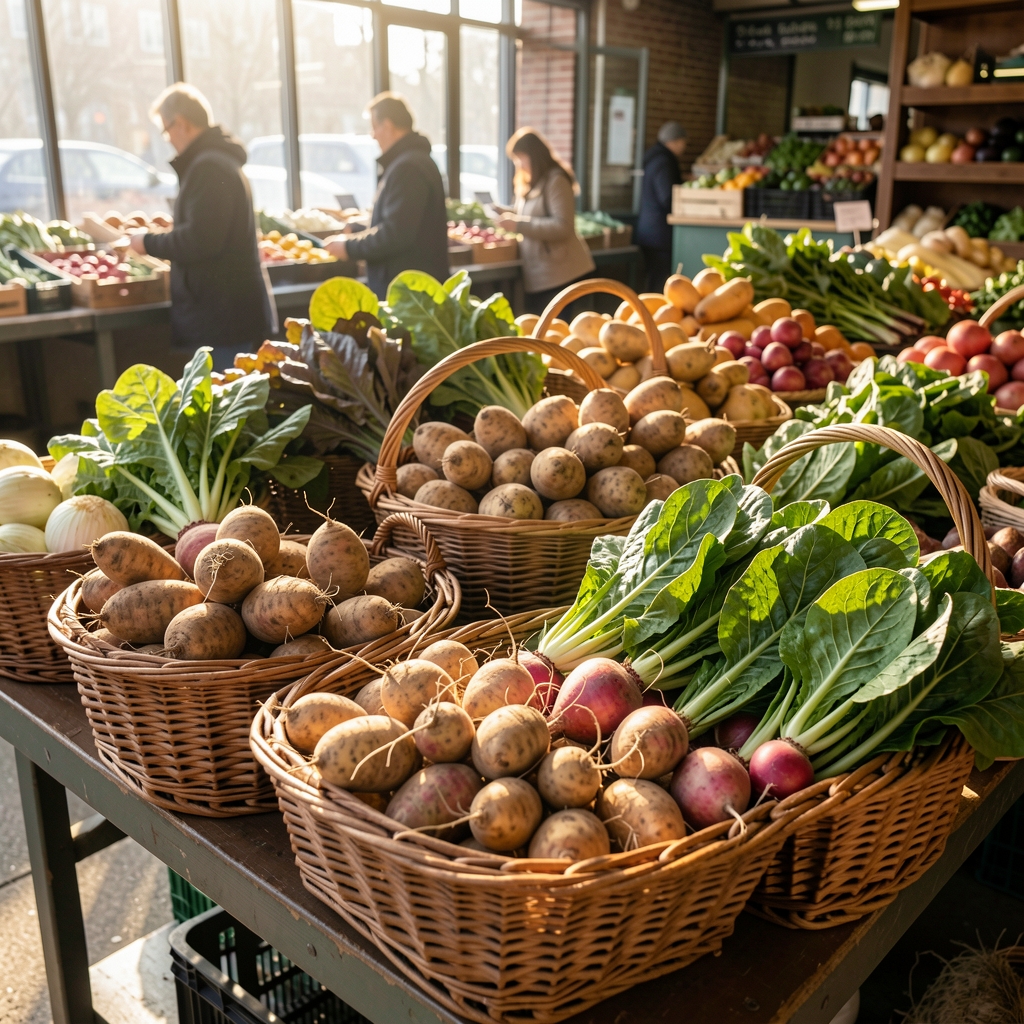
Market produce, early morning — London, winter 2026
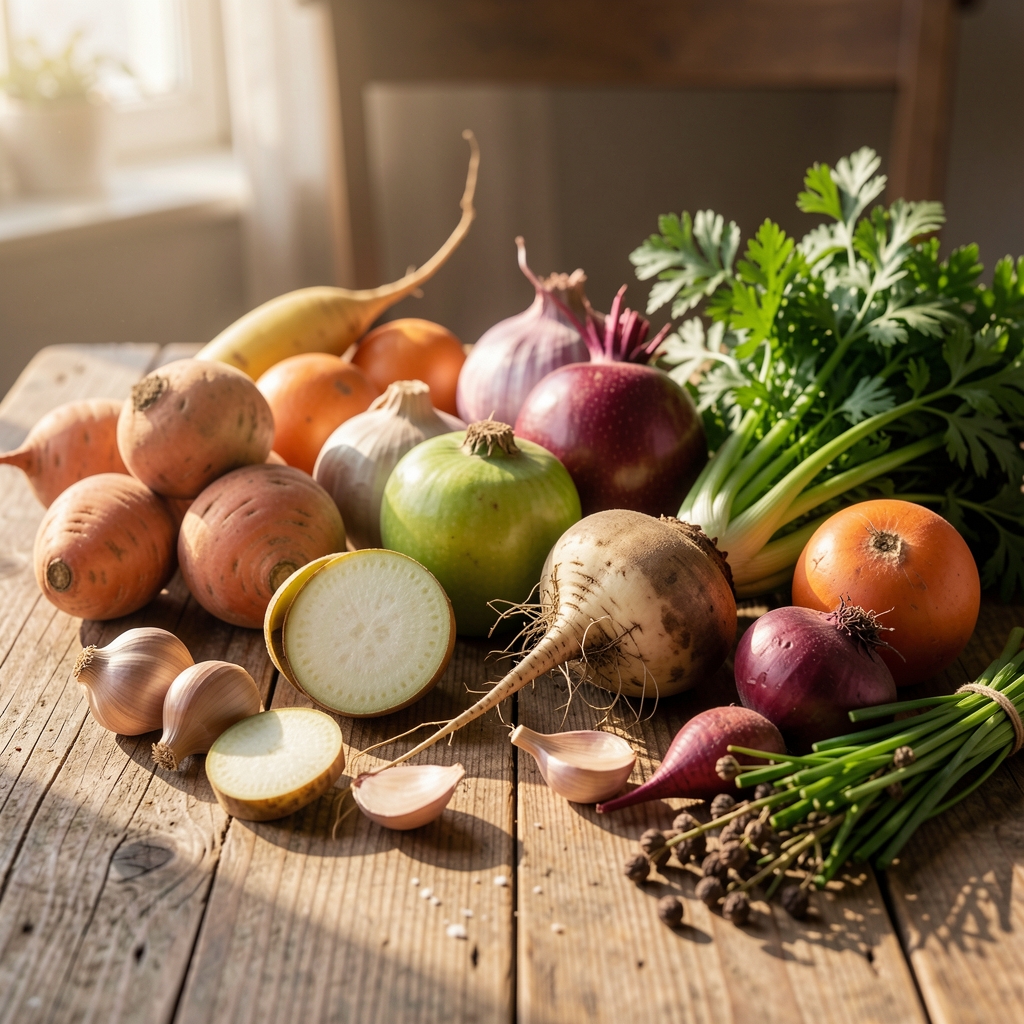
The winter market in London, stripped of the vivid summer surplus, reveals a quiet abundance of its own. Root vegetables — parsnips, celeriac, swede, turnip — carry a density that summer produce rarely matches. Their fibre content supports a sense of fullness between meals in a way that lighter seasonal foods do not.
Brassicas reach their peak from October through February. Kale, Savoy cabbage, Brussels sprouts, and purple sprouting broccoli offer a range of micronutrients that, when recorded in a food journal, appear consistently underrepresented in the spring and summer entries of the same diarist. This is not because they are missed — they are simply not there.
Alliums — the leek family in particular — bridge the seasons with a consistency that makes them reliable anchors for the winter plate. The nutritionist's field record notes their role not as a single-item solution but as a structural element: a base for soups, stews, and slow-cooked preparations that increase the proportion of plant-based material in each meal without requiring significant dietary reorganisation.
What the winter record shows, when reviewed in aggregate, is that the challenge is not one of scarcity — it is one of familiarity. The same three or four vegetables appear week after week in most journals. The nutritional consequence is reduced variety, not reduced quantity. Variety, in the evidence-informed view, is a dimension of dietary quality that quantity alone cannot substitute.
"The person who allows the market calendar to govern their choices eats a wider range of nutrients than the one who eats the same five vegetables year-round."
Falorin Journal — Field Notes, 2026The arrival of spring produce in the food journal is typically marked by an increase in variety. Asparagus, broad beans, peas, watercress, spinach, and early salad leaves appear in rapid succession from March through May, and the journal pages reflect this: more items per meal, more colour across the weekly record, a broader range of preparation methods.
The relationship between this seasonal variety and weight awareness is indirect but consistent. Meals built around a wider range of vegetables tend to carry a higher proportion of dietary fibre relative to caloric density. The person eating a broad variety of seasonal produce is, in practice, constructing meals with a different structural profile than those built around a narrower, year-round selection — and the food journal, reviewed over months, shows this in the pattern of portion sizes and between-meal eating.
Summer produce extends the variety window further. Courgettes, tomatoes, aubergines, cucumbers, green beans, fennel, and the full range of summer fruit all appear within a relatively compressed calendar window. The nutritionist's record from July and August typically shows the highest vegetable and fruit diversity of the year. It also, not coincidentally, shows the lowest instances of reported food monotony — the sense, noted by many food journal keepers, that eating has become repetitive and joyless.
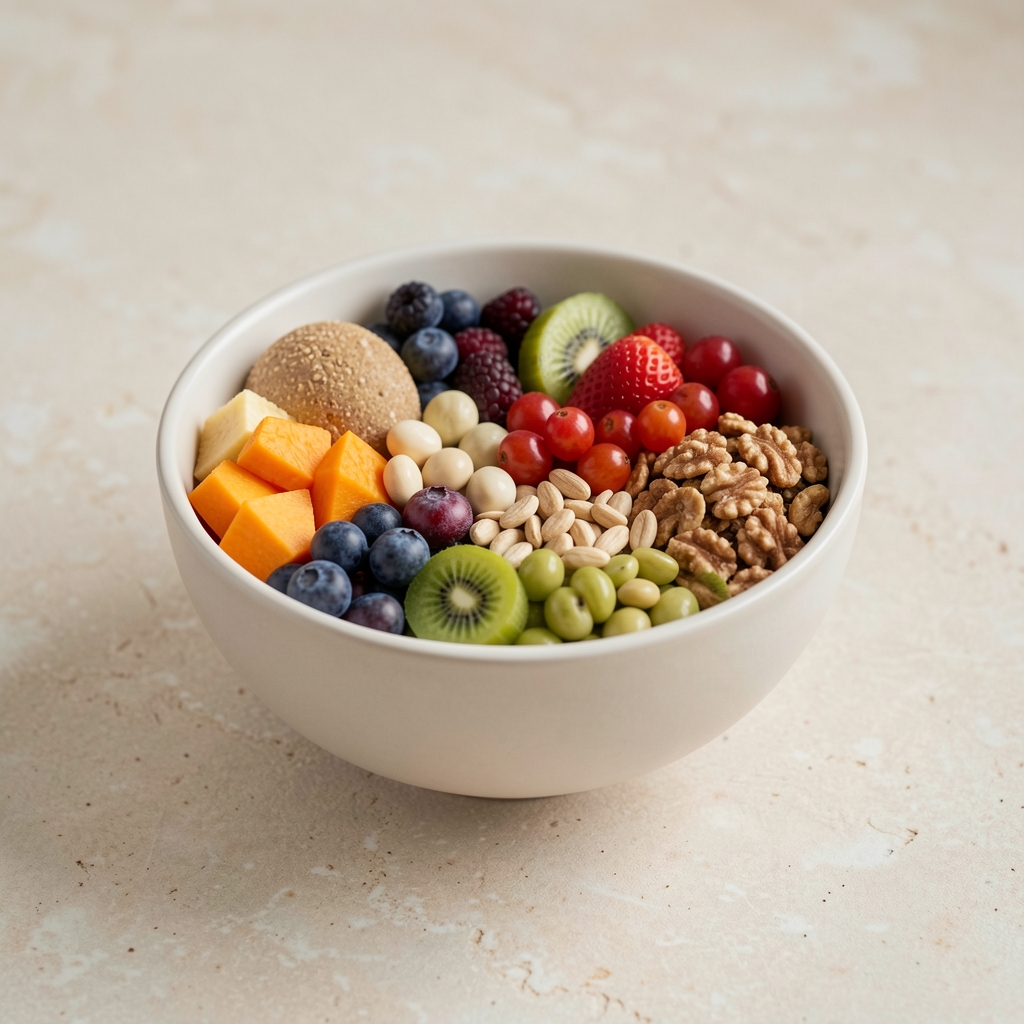
Fruit occupies a different position in the weekly nutritional record than vegetables, and the distinction matters for a nutritionist reviewing food journals. The natural sugar content of fruit, while accompanying a range of fibre, vitamins, and antioxidant compounds, means that its contribution to the daily food picture is most balanced when it is distributed across the week rather than concentrated in a single daily serving.
Seasonal fruit in the UK context follows a clear arc. Forced and imported strawberries are available year-round, but the British strawberry season is brief, intense, and nutritionally distinct from its out-of-season counterpart. Autumn brings damsons, plums, figs, and the full apple and pear harvest — a window of variety that, if used, substantially broadens the fruit record compared to the narrow year-round default of bananas, apples, and imported grapes.
The food journal entry that includes a blackberry picked from a London park in September carries a different nutritional footnote than the same person's January banana. Neither is incorrect. Both are contextual. The nutritionist's role is to observe which fruits are appearing in the weekly record and whether they are varying across the year — not to rank one fruit against another in isolation.
The weekly food rhythm that incorporates seasonal produce does not require wholesale reorganisation of shopping or cooking habits. The nutritional record shows that even small seasonal shifts — substituting a winter squash for a courgette in October, adding watercress to the spring salad bowl — register meaningfully in the variety column of the food journal over time.
A useful exercise for those keeping a food journal is to record not just what was eaten, but which produce appeared for the first time that season. The observation alone tends to prompt a gradual diversification of the plate that, in practice, neither restrictive dietary frameworks nor detailed nutritional planning reliably produces.
The nutritionist's field record for 2026 returns, month by month, to the same observation: the widest dietary variety comes to those whose weekly plate is loosely governed by what is presently growing, not by what is permanently available. The supermarket has erased the calendar from the shopping aisle. The food journal can restore it — one seasonal entry at a time.
Articles published on Falorin Journal are editorial in nature and reflect the writers' observations on everyday nutrition practices and weight awareness. The content is not intended as professional advice, nor as guidance for the management of any specific condition. Readers with specific concerns about their daily routines are encouraged to speak with a qualified wellness professional.
Eleanor Whitfield is the founding editor of Falorin Journal, where she maintains a long-form field record of everyday nutrition practices observed across London's markets and kitchens. Her editorial background spans fourteen years of writing on food patterns and weight awareness.
More from this author
A nutritionist's account of what six months of recorded daily eating reveals about the relationship between food choices and gradual weight change.
An editorial exploration of the relationship between daily movement levels and eating patterns, observed through a nutritionist's practice.